Vatnajökull Glacier Satellite Imagery
Operation NapoleonVatnajökull Glacier Satellite Imagery turns a faint mark in a field of ice into the beginning of a military operation—and, eventually, into evidence of a history the images cannot explain. Compared across time and interpreted alongside an old aircraft wheel, the photographs locate a German transport plane long buried on Vatnajökull Glacier. Their precision enables the search; their limits become apparent only when the wreck is opened and bodies emerge from the ice.
The surveillance system
The images are produced and interpreted within Building 312, a clandestine intelligence organisation housed in a converted warehouse not far from the Capitol in Washington, D.C. Giant computers receive satellite information, process and catalogue it, and raise an alert when something irregular appears. Its archive contains tens of millions of satellite photographs accumulated over four decades. The organisation controls eight satellites orbiting between 800 and 1,500 kilometres above Earth, and its work has shifted with its political purpose: established shortly after 1960 to analyse images of the Soviet Union, China, Cuba, and other countries treated as enemies, it later monitored terrorist bases in the Middle East and conflicts in the Balkans.
The photographs of Vatnajökull Glacier belong to this immense apparatus, but their significance lies in a small, local comparison. In the control room, Vytautas Carr studies an archival image and a new one on adjacent screens. One was taken about a year earlier; the other earlier that day. The older photograph shows an apparently unremarkable expanse of white ice interrupted by crevasses. In the newer picture, a small mark appears in the lower-left corner. The image is coarse and grainy, but magnification and enhancement bring the black mark into view. A vast surveillance system has narrowed its attention to a speck.
Detection and interpretation
The mark does not identify itself. Carr asks whether anyone is stationed in Keflavík and learns that the organisation has no one there. He then calls Ratoff, wary that the new alert might be another false alarm. Better satellite equipment has made the glacier visible with a clarity not previously possible, but the photographs still require interpretation. Carr later notes that the coordinates are different from those of an earlier location: the glacier is moving, so the target does not remain fixed on the landscape.
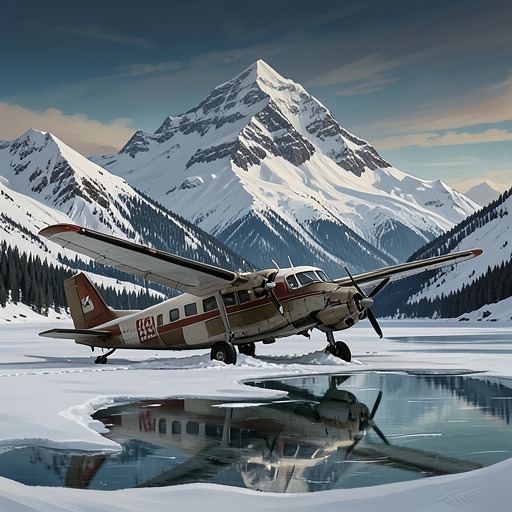
A separate piece of physical evidence gives the images their force. Carr takes an aircraft wheel from a glass cabinet and rereads the inscription Kruppstahl. Its manufacture, size, and capacity correspond to the type of plane believed to have crashed, while the wheel itself confirms that a wreck lies on the glacier. The photographs add a location to that material clue. On the basis of its images, Ratoff tells Jón that the aircraft’s nose is visible above the ice and that the coordinates are known. The image is therefore not simply a record of the glacier: it is a changing map of a buried object becoming exposed.
From long surveillance to a new expedition
The photographs belong to a search that has already extended across generations of technology. Shortly after the plane crashed, a 200-man team searched the glacier and found only the wheel. A much larger expedition in 1967 was forced off the ice by bad weather. The operation under way now is the third. Military intelligence has monitored changes in the relevant area since the end of the war, first through aerial photographs taken by spy planes and, after satellites became available, from space. The ongoing record allows Carr to argue that the search is closer to finding the aircraft than ever before.
Carr presents the satellite images to the U.S. Secretary of Defense as evidence of an aircraft believed to have crashed on the glacier in the closing stages of World War II, probably a German Junkers transport. Yet he is not simply eager to recover it. He tells the secretary that it might have been better if the glacier had kept the plane hidden forever, and that the principal concern had been to check that it had not reappeared. The images thus create a dilemma as well as an opportunity: they make recovery practicable while showing that concealment may be ending. Their disclosure also brings the operation into political view. Carr must account for a C-17 transport plane left idle in Iceland and for the presence of Delta Force operators, and he hands the secretary the images as the concrete basis for discussing the mission.
What the images cannot show
The satellite record can indicate where the wreck is and help guide personnel to it, but it cannot disclose what the aircraft carried, who was aboard, or why the flight matters. Those questions surface only during the recovery. As workers cut through the fuselage, Ratoff finds bodies preserved in the ice: first a German officer outside the plane, then two men in the cabin, one of them wearing the uniform of a two-star U.S. general and handcuffed to an aluminium briefcase. In the tail he finds three more bodies, including a young American wearing a World War II fighter pilot’s jacket. Ratoff counts six corpses, although his briefing had led him to expect seven.
This discovery marks the boundary between detection and knowledge. The images have made the aircraft a target, but the bodies contradict any simple expectation that it was an ordinary German transport: the wreck contains both German and American uniforms, including a U.S. general and an American pilot. Nor can the satellite view explain the arrangement of the dead or the circumstances of their deaths. At the recovery site, Ratoff encounters physical traces the photographs could never resolve: an officer’s Iron Cross, frozen clothing, a missing leg, and a briefcase secured to a wrist. The machine sees the plane’s shape in the ice; its contents require a human investigation.
Significance
The imagery’s narrative power comes from the gap between what it reveals and what it leaves concealed. First it registers only a dark mark; enhancement makes that mark legible as a likely aircraft; continued surveillance helps locate a nose emerging from the glacier. Each increase in visibility advances the recovery, yet none answers the central historical questions raised by the wreck. Even the full exposure of the aircraft does not immediately settle what happened: its preserved bodies complicate the picture supplied to Ratoff, while the expected seventh passenger remains unaccounted for.
The photographs also connect different scales of power. A detail on an Icelandic glacier passes through orbiting satellites, an archive of decades of intelligence, a control room in Washington, D.C., and a briefing with the Secretary of Defense before it sends soldiers onto the ice. That chain makes the images both instruments of knowledge and instruments of state action. Their most decisive consequence is not that they explain the past, but that they make a concealed past physically reachable—and force the people directing the search to confront what the recovered record contains.